Pediatric Noise

By Interacoustics

What is the pediatric noise stimulus?

Pediatric noise is a special noise stimuli that can be used as an alternative for pure tones, warble tones and narrow band noise. The use of pediatric noise is useful during sound field testing and visual reinforcement audiometry (VRA) as it helps to avoid standing waves as well as maintain the child's interest during testing. In additional it is useful in other assessments, which requires narrow band noise such as pitch matching and minimum masking level. Pediatric noise addresses the two problems related to the use of narrow band noise.

1. Pediatric noise is calibrated in dB Hearing Level

In comparison, the narrow band noise is calibrated for effective masking of tonal sounds of the same dial setting. Practically speaking it means that the narrow band noise is a few dB louder than what is required for threshold measurements.

2. The shape of pediatric noise makes it frequency specific

While the plateau of the pediatric noise and narrow band noise are of the same width, the pediatric noise has very steep slopes, 100dB/octave vs. 12dB/octave respectively. In case of sloping hearing losses, the use of pediatric noise will not result in off-frequency listening.

Below graph illustrates the shape of the pediatric noise at 1000Hz.
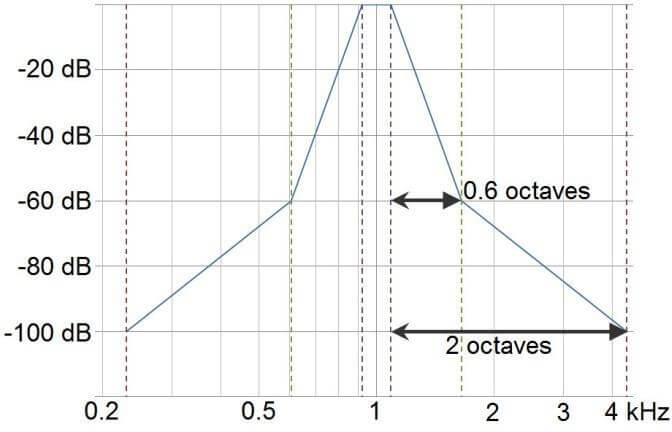
Graph with dB as a function of kHz. The curve itslef ascends from -100 dB to -60 dB, and the slope is even more steep from -60 dB to its peak at 1 kHz. It then descends with the same shape, although across a wider range of frequencies. 0,6 octaves are marked with an arrow between 1 and 2 kHz. 2 octaves are marked with an arrow between 1 and slightly over 4 kHz.

Required equipment

  • Headphones, insert phones or free field setup (FF)
  • AC40

How to select pediatric noise

Ped noise can be run ad stand-alone on the audiometer or via Diagnostic Suite.
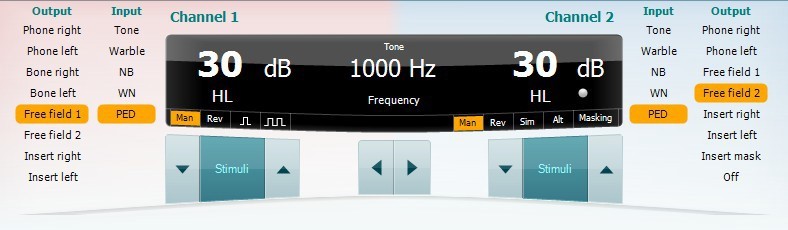
Test overview in Diagnostic Suite, with 'PED' marked in orange for channels 1 and 2.

  1. On the standalone device, press Tests and use the wheel to select PED: pediatric noise. When in the PED test screen, the channel 1 Warble button will flash slowly, to indicate that the stimulus used is the pediatric noise. While using this protocol, the audiometer allows toggling from pediatric noise to tone, warble tone and back to pediatric noise. Note: If operated through Diagnostic Suite, pediatric noise (PED) will be available from the main tone screen in the selection of input.
  1. Conduct threshold evaluation using the pediatric noise for the desired audiometric evaluation method.

Presenter

Interacoustics

Available Training

How to install and use Diagnostic Suite with your AS608

In this video, you'll learn how to install and use Diagnostic Suite with your AS608. Watch the video here.

Interacoustics2026-10-28

Diagnostic Suite: How to create a print template

In this video, you'll learn how to create a print template with Diagnostic Suite. Watch the video here.

Interacoustics2026-10-28

Diagnostic Suite: How to share a print layout design

In this video, you'll learn how to share a print layout design with Diagnostic Suite. Watch the video here.

Interacoustics2026-10-28

Short Increment Sensitivity Index

Learn how to perform the short increment sensitivity index (SISI) test in the Diagnostic Suite software.

Interacoustics2026-10-28

High Frequency Audiometry

Learn how to perform high frequency audiometry with in the Diagnostic Suite software.

Interacoustics2026-10-28

Tone Decay Test

Learn how to perform the tone decay test in the Diagnostic Suite software.

Interacoustics2026-10-28

Speech Audiometry

Learn how to perform speech audiometry in the Diagnostic Suite software, including results interpretation.

Interacoustics2026-10-28

Pure Tone Audiometry

Learn how to perform pure tone audiometry in the Diagnostic Suite software.

Interacoustics2026-10-28

Weber Test

Learn how to perform the Weber test in the Diagnostic Suite software, including results interpretation.

Interacoustics2026-10-28

Quick Speech in Noise (QuickSIN)

Learn how to perform the quick speech in noise (QuickSIN) test in the Diagnostic Suite software, including results interpretation.

Interacoustics2026-10-28

Threshold Equalizing Noise (TEN) Test

Learn how to perform the threshold equalizing noise (TEN) test in the Diagnostic Suite software, including results interpretation.

Interacoustics2026-10-28

Masking Level Difference (MLD)

Learn how to measure the masking level difference (MLD) in the Diagnostic Suite software, including results interpretation.

Interacoustics2026-10-28

Looking for clinical training?

Are you looking for more advanced and clinical training?