
Interacoustics Academy Clinical Diploma
Videonystagmography (VNG)

What is the Clinical Diploma?
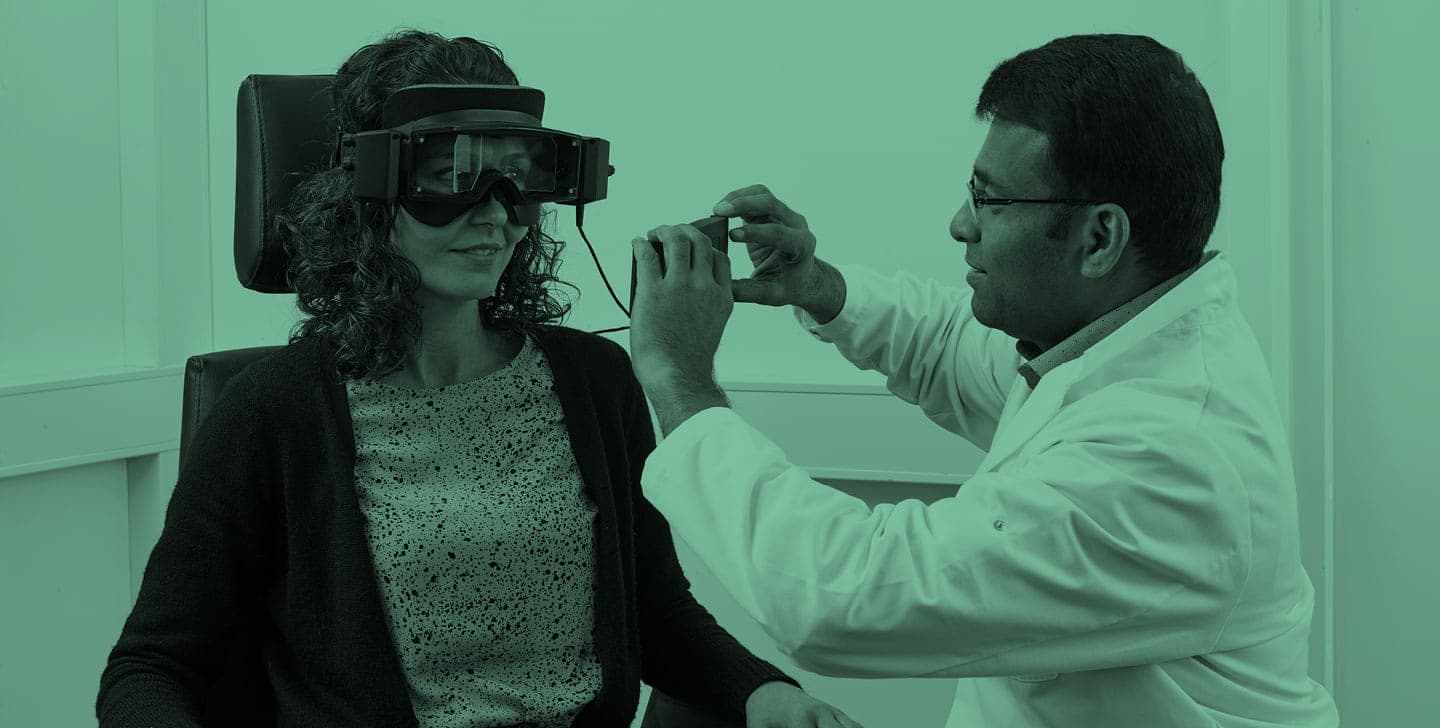
The Clinical Diploma is an online course designed to deliver theoretical and practical training for the assessment of eye movement in patients with symptoms of dizziness and suspected vestibular dysfunction. Covering the anatomy and physiology of the vestibular sensory system pathways, assessment of eye movement and associated ocular motor pathways, positional and positioning testing, and the ear specific assessment of the peripheral vestibular system horizontal semicircular canal response with caloric irrigations. this course will equip delegates with the knowledge and skills to perform accurate VNG assessments in the adult population.

How does the course work?
You will follow case studies through from the point of referral, via the diagnostic process to the point of decision making regarding their management. Video presentations, demonstrations and practical sessions will be used to familiarise delegates with all aspects of VNG testing. Your Interacoustics Academy course tutors will guide you through a series of interactive tasks and knowledge checks, as well as practical components to allow you to get hands-on, to facilitate the optimum learning experience.

Who is this course for?
The course is designed for anyone who is performing or Interpreting VNG. Medical professionals such as ENT, Otoneurology, Neurology, Audiology and Physical Therapy can all benefit from the content in this course.
Lesson 1 - Introduction to dizziness and VNG
- Prevalence and incidence of dizziness
- Symptoms: what does this mean for the patient
- Causes of dizziness
- The balance system and pathway assessed by VNG
- The balance pathways
- The different types of eye movements
- Introduction to recording of eye movement
- Introducing VNG as a test technique
Lesson 2 - The patient referral ... how do I get started
- Who requests a VNG assessment
- How to create the ideal testing
- Why does a ENT specialist refer for VNG assessment
- Why does a Neurologist refer for VNG assessment
- Are Neurology and ENT looking at the dizzy patient in the same way with VNG?
- The patients reported history
- Medication and their effects on VNG testing
- Assessment of the functional changes in the dizzy patient
- Clinical use of Dizziness Handicap Inventory
- What other assessments might you want to perform prior to VNG
Lesson 3 - Preparing for the VNG assessment
- How to create the ideal testing environment
- Visual Stimuli presentation options
- Setting up the stimulus screen
- VNG goggle hardware and software introduction
- Side mounted camera VNG goggle
- Top mounted camera VNG goggles
- Creating a VNG test protocol
- How does a VNG system track eye movement
- What do VNG traces look like
- Calibration of the patient's eye movement for VNG
- Calibration of eye movements for VNG
- Calibration errors
Lesson 4 - Getting to know eye movements
- Introduction to Eye Movement assessment
- What is 'normal' eye movement
- Understanding Eye Movement
- Torsional eye movement
- Eye muscles
- Eyes muscle pairings and associated eye movement
- Horizontal, Vertical and Torsional recording of eye movement
- Anatomy and physiology of eye movements
- What measurement of eye movement do we use to evaluate the inner ear
- What is nystagmus
- What does nystagmus look like on in VNG recording?
Lesson 5 – Spontaneous eye movement assessment
- Static assessment of eye behaviour
- Anatomy & Physiology - Spontaneous eye movement pathways
- Setting up and running a spontaneous nystagmus test
- Protocol Settings
- Running the Test
- Abnormal results & identifying nystagmus
- What other spontaneous eye movements are there
- Artefacts and tester errors
Lesson 6 - Gaze Stability assessment
- What is a Gaze test
- Anatomy of eye movement for gaze testing
- Functional pathways for gaze testing
- Setting up for a gaze test measurement
- Gaze testing in action
- What does a normal gaze test look like
- What does an abnormal gaze test look like
- Clinical significance of Gaze testing
- Artefact and test errors
Lesson 7 - Saccadic eye movements
- What is Saccade testing
- Anatomy of saccadic eye movements
- Functional pathways for saccadic eye movement
- Setting up for a saccade measurement
- Saccades in action (horizontal)
- Saccades in action (vertical)
- Normal saccade response
- Abnormalities in saccadic eye movements
- Clinical significance of saccade testing Artefacts and test errors
Lesson 8 - Smooth pursuit testing
- Assessment of the pursuit systems
- Anatomy of pursuit pathways
- Functional pathways involved in pursuit
- Setting up for a smooth pursuit
- Smooth pursuit in action
- What does normal smooth pursuit look like
- What does an abnormal pursuit test look like
- Clinical significance of pursuit assessment
- Artefacts and test errors
Lesson 9 – Optokinetic Test
- Anatomy and functional pathways of the OKN system
- Setting up for optokinetic assessment
- Running an optokinetic assessment
- What does a normal OKN test look like
- What does an abnormal OKN test look like
- Clinical significance of OKN assessment
- Artefact and test errors
Lesson 10 - Positional testing
- What are we looking for in positional testing
- Setting up to test positional eye movements
- Performing a positional eye movements exam
- Normal positional eye movements exam
- Abnormal positional eye movements exam
- Clinical significance of positional assessment
- Artefacts and test errors
Lesson 11 - Positioning Assessment
- What are we looking for in dynamic positioning testing
- Performing the positionings procedure
- Interpretation of abnormal findings
- Clinical significance of the positioning assessment
- Artefacts and test errors
Lesson 12 – Caloric Testing
- The Caloric Irrigation Test
- Functional anatomy and physiology of the horizontal / lateral semi-circular canal
- Mechanisms of the Caloric Test
- Setting up and Running a Caloric Test
- Patient instructions and performing the test
- The normal caloric response
- What does an abnormal caloric response look like
- Technical tips for caloric testing
Lesson 13 - Additional tests in VNG (VOR assessment)
Ocular Counter Roll (OCR) test
- Setting up for OCR test measurement
- Performing the OCR test
- The normal OCR response
- The abnormal OCR response
- Clinical interpretation of the OCR
- Artefact and test errors
Headshake nystagmus (HSN) test
- What does a normal HSN test look like
- VNG recording of eye movement
- What does an abnormal HSN test look like
- Artefact and test errors
Lesson 14 – Additional tests in VNG (advanced oculomotor)
Saccadometry
- Setting up for a saccadometry assessment
- Performing a saccadometry assessment
- What does a normal saccadometry assessment look like?
- What does an abnormal saccadometry assessment look like?
- Clinical interpretation of Saccadometry
- Artefact and test errors
- Clinical significance of Saccadometry
Lesson 15 - A case-based approach (peripheral vestibular conditions)
- Putting the VNG assessment together
- Report writing following the VNG assessment
Lesson 16 – Central conditions and their effect on VNG assessment
- Review of central conditions and pathologies on VNG assessment
Lesson 17 - The diagnostic vestibular assessment toolbox
- Introduction to multifrequency SCC VOR assessment (vHIT / RCT / Caloric)
- Introduction to Otolith assessment (cervical VEMP and ocular VEMP)
What do I need to do?
In order to obtain the Interacoustics Academy Clinical Diploma, you will need to navigate through the course. There are a total of 17 lessons, each of which should take between 1 and 2 hours to complete. However, there is no set time limit and you can revisit each lesson as many times as you wish. You may take as long as you wish to complete the full course. Through the course you will find a series of tasks, questions and interactions to assist in your learning experience and check your knowledge. Some of these tasks are compulsory and you will need to submit evidence of completion to the Interacoustics Academy in order to obtain your Diploma. At the end of the course, the final step is completing an exam, which you must achieve a score of 80% or higher in order to pass. After you have passed the exam and submitted the compulsory tasks, we will be delighted to award you with your Clinical Diploma Certificate.
Cost: $850 USD
Presenters: Darren Whelan, Leigh Martin, Michael East and Amanda Goodhew.

Darren Whelan
Darren Whelan holds an undergraduate degree in audiology and postgraduate master’s degrees in health science, neurophysiology, and clinical research. His resumé includes several clinical positions in the National Health Service (NHS). Prior to his current occupation as an International Clinical Trainer in the Interacoustics Academy, Darren held a clinical audiology and research scientist role in the UK, where he investigated patients with auditory and vestibular pathology, and managed a portfolio of NIHR adopted research studies. He has been a guest speaker at national and international conventions, enjoys teaching and providing clinical insights on the management of patients with dizziness and is a contributing author on published audiological and vestibular articles. Darren has also been an adjunct professor at Salus University in the USA, lecturing on the Doctor of Audiology degree.

Leigh Martin
Leigh Martin is a British Audiologist and adjunct lecturer at the University of Cork, Ireland. Clinically, he has worked in the National Health Service specializing in paediatric audiology as well as vestibular diagnostics and rehabilitation. Leigh has also sat on the board of directors for the British Academy of Audiology. Since 2013, Leigh has supported the growth and development of the Interacoustics Academy and holds the position of Global Manager of the Academy. Leigh has presented at numerous scientific conferences and meetings across a diverse range of audiological topics as well as having published papers in both video head impulse testing (vHIT) and wideband tympanometry.
Michael East
Michael is an Audiologist and Clinical Scientist from the UK with many years of experience working in senior clinical audiology positions within the National Health Service, specializing in both pediatric and vestibular assessment/rehabilitation. He holds undergraduate and postgraduate degrees from the University of Southampton and Aston University respectively and completed the UK’s National School of Healthcare Science “Scientist Training Program”; leading to his registration as a Clinical Scientist.

Amanda Goodhew
Amanda holds a Master's degree in Audiology from the University of Southampton. She has extensive experience holding senior audiologist positions in numerous NHS hospitals and clinics, where her primary focus has been paediatric audiology. Her specific areas of interest are electrophysiology, neonatal diagnostics and amplification, and the assessment and rehabilitation of patients with complex needs.
Payment
Direct payment is by credit card. If you are unable to pay by credit card and require a purchase order to be raised, please contact your local Interacoustics representative for assistance. If you are intending to make a bulk purchase of multiple Diplomas then please also contact your local Interacoustics representative for pricing information.
Fee: 850 USD
This diploma course is intended to provide learners with an educational experience to improve their understanding and facilitate the development of clinical skills in the field of Videonystagmography. It should be noted that this diploma course and/or the diploma certificate (as such) does not confer clinical competence or provide an assessment or qualification of the learner’s ability, skill or proficiency in the tests and fields described during the diploma course. Interacoustics assumes no liability for the materials provided – whether at the website or in the materials provided at the diploma course – and disclaims all liability for damages of any kind arising out of use.