
P300/MMN Recording
What is the mismatch negativity (MMN) response?
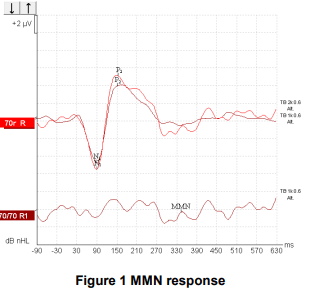
The mismatch negativity (MMN) response is a negative wave elicited in an 'oddball' paradigm where by a deviant stimuli is presented amongst a stream of repeated, or standard, stimuli. The response can be observed by subtracting the responses to the standard stimuli from those of the deviant, and it occurs in the latency region of around 100-300ms. See Fig1, showing an MMN from a 2 kHz deviant tone burst presented amongst a stream of 1 kHz standard tone bursts, measured between vertex and linked- mastoid positions.
What is the P300 response?
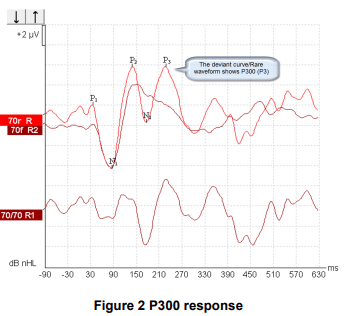
The P300 response is a positive wave that is also usually elicited in an oddball paradigm. Unlike the MMN, which can be measured without any task requirements, the P300 only occurs when the listener is actively attending to the stimuli. See Fig 2, showing a P300 from a 2 kHz deviant tone burst presented amongst a stream of 1 kHz standard tone bursts, measured between vertex and linked- mastoid positions.
Why MMN/P300?
The MMN and P300 can be used to evaluate higher level auditory function. The MMN test is particularly related to the brain's ability to discriminate between speech sounds, and its independence of attention may make is suitable for use in evaluating auditory function in various populations in clinical neuroscience and in infants and newborns (Garrido et al., 2009).
How to measure the MMN/P300 responses
Patient preparation
Patient arousal and attention state greatly affects the amplitudes of the MMN response, so it is very important that the patient understands the test procedure. The MMN can also be elicited when the subject pays attention to stimuli, but it is difficult to measure in this condition because of the overlapping N2 component. As a result it is recommended to record the MMN while the subject ignores the stimuli.
This can be done by letting the subject read or watch a silent captioned video during recording.
The MMN amplitudes decrease with various stages of sleep. It is not advised to perform MMN under sedation.
Electrode placement
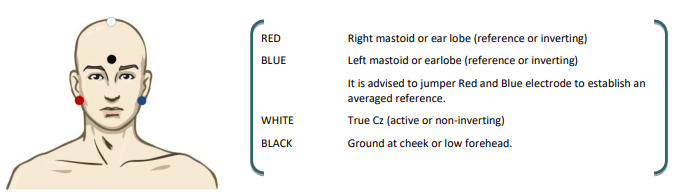
It is possible to obtain P300/MMN with a standard 2-channel electrode montage, with an active vertex electrode referenced to either right or left mastoid. However, stronger responses can be obtained by linking the right and left mastoids, recording both from the ipsilateral and contralateral side in order to avoid a bias in hemispheric laterality.
Setting up the Eclipse
The Eclipse comes with a pre-programmed protocol for P300/MMN testing (license), ready for immediate use. Protocols can be created or modified easily to fit your clinic needs. Consult your Eclipse Additional Information to learn how to create or modify a protocol.
Protocol settings
- P300/MMN should be measured using toneburst from 250 Hz-4 kHz and custom wave files at an intensity of a moderate levels.
- Custom wavefiles inclusing Da, Ba and Ga are placed on the EPx5 CD-ROM. Please refer to the chapter Importing wavefiles for stimuli in Instruction for Use for guidelines on importing and calibrating custom wavefiles.
Summary of parameters for P300 and MMN
| P300 response | MMN | |
| Patient state | Awake and quiet | Awake and quiet |
| Eyes | Open | Open |
| Conditions | Attend | Ignore conditions |
| Types of stimuli | Tone burst, speech vowels or consonant-vowel combinations | Tone burst, speech vowels or consonant-vowel combinations |
| Inter-onset interval | 0.1 to 1 second | 0.1 to 1 second |
| Stimulus duration | 50 to 300 ms: Be careful of overlapping response if analysis time is short | 50 to 300 ms: Be careful of overlapping response if analysis time is short |
| Presentation | Oddball paradigm, deviant probability 0.05 to 0.20, number of deviants at least 200 | Oddball paradigm, deviant probability 0.05 to 0.20, number of deviants at least 200 |
| Intensity | 60 to 80 dB peSPL | 60 to 80 dB peSPL |
| Reference electrode | Tip of nose of averaged reference (jumped electrodes) | Tip of nose of averaged reference (jumped electrodes) |
| Filtering | 1 to 30 Hz | 1 to 30 Hz |
| Analysis time | Pre-stimuli: -100 ms Post-stimuli: 700 ms or more |
Pre-stimuli: -50 ms or more Post-stimuli: 400 ms or more |
| Deviant sweeps | 50 to 300 | 50 to 300 |
| Replications | At least 2 / at least 200 deviants | At least 2 / at least 200 deviants |
| Measurements in adults | P1, N1, P2 and P3 | N1, P2 and MMN |
| Measurements in children | P1 and N200-250 | Use difference waveform (response to deviant) |
| Measurements in infants | Replicable components | Use difference waveform (response to deviant) |
| Measures | Baseline to peak amplitude, peak latency Use latency window established using grand mean data |
Baseline to peak amplitude, peak latency Consider mean MMN amplitude in response window Use latency window established using grand mean data |
| Response presence determined by | Replicable components Response 2-3 times larger than amplitude in pre-stimulus interval |
Replicable components Response 2-3 times larger than amplitude in pre-stimulus interval |
References
Garrido, M. I, Kilner, J.M, Stephan., K.E., and Friston, K.J. (2009) The mismatch negativity: A review of underlying mechanisms. Clinical Neurophysiology 120 453-463.
Hall, J.W. (2007). New Handbook of Auditory Evoked Responses. Pearson
Picton, T. (1992) The P300 wave of the human event-related potential. Journal of Clinical Neurophysiology 9 (4) 456-479.
Presenter