Mastering Tympanometry

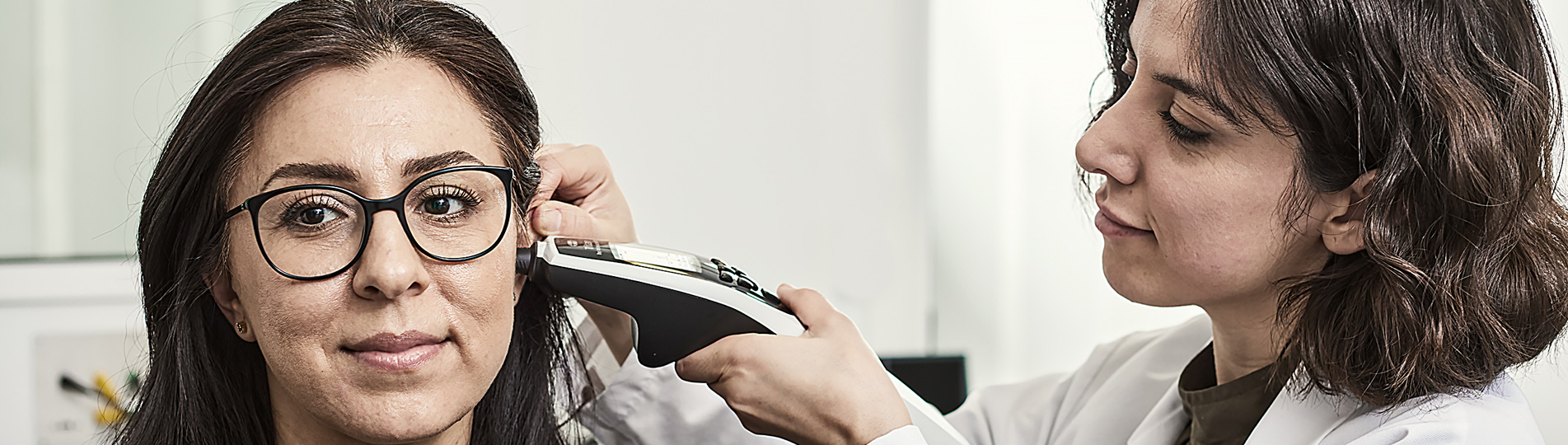
Welcome to this Interacoustics Academy Learning Path, on the topic of tympanometry. This course is designed to equip you with the theoretical and practical understanding of how to perform tympanometry. This course will explore the fundamental concepts of tympanometry, the clinical utility of tympanometry as a diagnostic tool, how to perform a measurement on a patient, the settings and parameter options available to devise a protocol for testing, and the important components of a recorded measurement to consider to make the interpretation of a result.
Learning objectives
- Describe the different components of a tympanometry measurement
- Describe the clinical utility and limitations of tympanometry
- List the different parameters that can be selected for a tympanometry measurement
Course faculty
Amanda Goodhew, MSc Audiology
Amanda holds a Master's degree in Audiology from the University of Southampton. She has extensive experience holding senior audiologist positions in numerous NHS hospitals and clinics, where her primary focus has been pediatric audiology. Her specific areas of interest include electrophysiology (in particular ABR, ASSR and cortical testing), neonatal diagnostics and amplification and the assessment and rehabilitation of patients with autism and complex needs. Amanda has a particular interest in pediatric behavioral assessment and has twice held the Chairperson position for the South London Visual Reinforcement Audiometry Peer Review Group. Amanda also works as an independent technical assessor for the United Kingdom Accreditation Service, undertaking quality assessment for audiological services throughout the UK, and provides guest lecturing services to universities both in the UK and abroad.
Dr. Kren Monrad Nørgaard, Ph.D.
Kren Monrad Nørgaard holds an Industrial Ph.D. in Acoustics from the Technical University of Denmark, following his graduation from the University of Southern Denmark in 2013 as a MSc Eng, Acoustics and Signal Processing. Despite his young age, Kren already has several years of experience at Interacoustics, firstly as an Acoustics Engineer, then as an Industrial Ph.D. Student followed by his current role as Principal Acoustics Engineer. Kren also boasts several publications in connection with his acoustics research.
Dr. Navid Shahnaz, Ph.D.
Dr. Shahnaz is an Associate Professor of Audiology in the School of Audiology & Speech Sciences at The University of British Columbia (UBC), where he has been since July 2002. He has also been working as an audiologist during this time in a private practice. Before joining UBC he was an Assistant Professor of Speech and Hearing Sciences at University of Arizona. He received his MSc (1996) and PhD (2000) degree in audiology and communication sciences and disorders from The School of Communication Sciences and Disorders, McGill University. During his residency at McGill University, he served as a faculty lecturer and clinical supervisor of audiology for three years. Before joining McGill University to pursue his studies he was working as a clinical audiologist, instructor, and researcher for six years at Tehran Medical Sciences University and in other private practice sectors in Tehran, Iran. Dr. Shahnaz's main area of research interest is diagnostic audiology, specifically multi-frequency tympanometry and wide-band energy reflectance in newborns, children, and adults.